top of page

All Posts

Once upon a time, I had a beautiful habit. You see, like many other young teenagers who grew up with fairly unrestricted access to the Internet, I found comfort in having a secret online identity on a niche website where I could freely air my thoughts and vent my frustrations without anyone I knew associating that to me. For me, this came in the form of a three-year long habit of regularly posting on a poetry-sharing site.


I wrote freeform poetry, bending words to drip with angst and twisting sentences to fit the theatrics of my teen life. Looking back on it, I can laugh at how meaningless it all seems now but, back then, I considered this a lifeline. I liked referencing little details from my daily life in throwaway rhymes, little nods that made sense to no one but me. I liked writing enigmatic titles for my poems that seemed too loosely connected to the poem itself. I shared my deepest feelings and wants, regrets and thoughts... Those close to me were aware of my passion for writing, but I was too shy to show them the kinds of things I really wrote about, thinking they´d shed light on some irrevocable truth, like I was hiding some kind of ugly monster inside of me that shone through my petty words and would have driven them all away. However, time and perseverance showed me the truth.


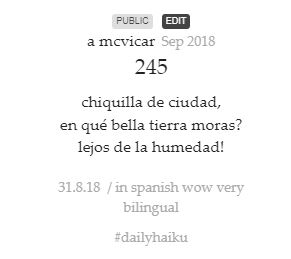
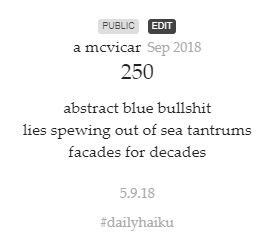
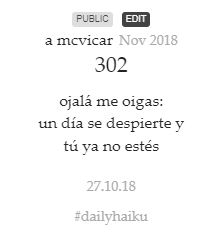
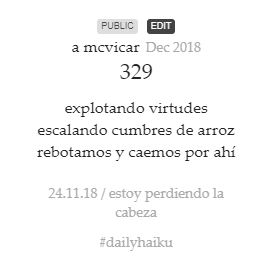
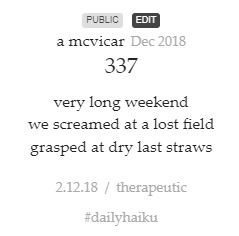
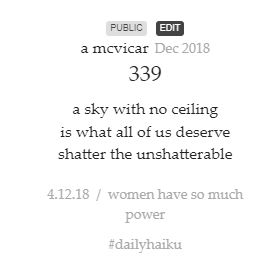
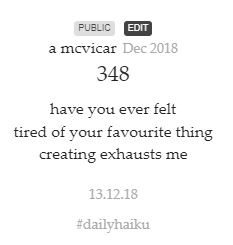
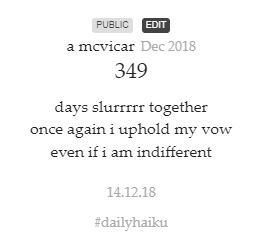
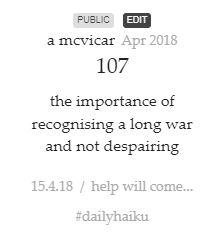
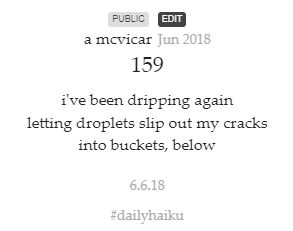
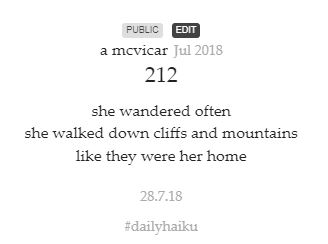
I worked up some courage and become a little bit more ambitious with my writing. I challenged myself, on the 1st of January of 2018, to write a daily short poem following the typical structure of a haiku. I succeeded in this challenge, and had produced 365 short poems a year later. This challenge made me view the world differently, as I got used to always looking around me to find inspiration for poetic metaphors and imagery that could convey hard truths about the human (and my!) psyche and soul. It inspired me for (what felt like) a long time and thanks to it, I wrote both the cringiest and the best short poems I recall ever producing. Eventually, I even self-published a short poem collection called "Stone Cold Bench", as a present to my mother, who has always been my greatest supporter and who had pushed me to write from the start.


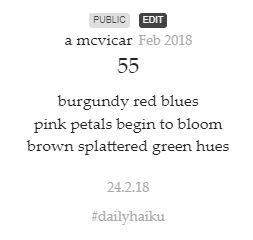
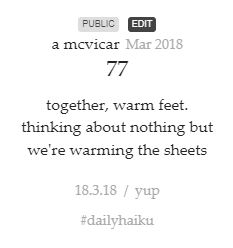
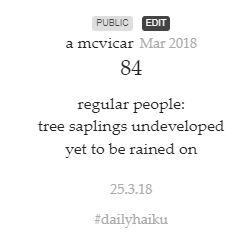
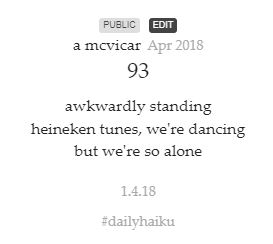
I did, regrettably, stop writing a daily haiku once 2018 was over. Admittedly, I did get burned out eventually and saw it as more of a self-imposed task than a creative outlet. However, I now wish I had carried on this habit until now. My current situation has me now re-challenging myself to develop my writing skills in a major way. Because being good at one thing won´t cut it anymore, not in our world. Amid this Herculean task, the threat of burnout is ever existent, and thus my mind was drawn back to my "2018 daily haiku challenge". I found my old blog and pulled out some of my favourite entries of the challenge, which I will be sharing below. It grounded me, reminded me that I have grown much already (most of the haikus were terrible!) but that I still have a long way to go. It momentarily paused the vertigo of trying to become a part of the modern creative workforce that is being quickly consumed by AI drones. But, most importantly, it reminded me of why I got here in the first place. Of why I wanted to write for a living. Of the feeling of posting something and firmly believing somewhere, someone you don´t know cares about your words. It is the swift kick I needed. I can´t wait to see what I do next!


SiM's promotional posters for their PLAYDEAD Tour. (Photo credits: AVO Magazine)

Is there a feeling better than going to a small gig and expecting a decent but average concert, only for your expectations to be blown out of the water? After seeing SiM live for their PLAYDEAD Tour, at Glasgow’s iconic venue The Garage, I know for a fact that the answer is a resounding no. For those of you who are unfamiliar with them, SiM is a Japanese alternative four-piece band that has been rocking increasingly international audiences since they first formed in 2004. Their style is pretty unique, clearly influenced by genres like heavy metal, reggae, alternative rock, J-rock, punk, ska and hip hop, which blend to create irreverent melodies that are perfectly matched by frontman’s MAH unruly and powerful vocals. The opening set, performed by Londonder alternative rap trio Frozemode, also perfectly matched SiM’s performance and had the crowd jumping before the main act had even started.


Frozemode for their latest Mixtape. (Photo credits: Kerrang!)

SiM made a name for themselves in Japan and eventually signed with Pony Canyon in 2022. They then released their smash hit “The Rumbling”, which became the opening theme for the final season of the highly anticipated anime Attack on Titan. This brought SiM to Western audiences’ attention, and the band has only gotten bigger since then. Considering the success of “The Rumbling”, I was not surprised to see tons of Attack on Titan merch (and even some cosplays!) among the crowd. It also did not surprise me that SiM left this monumental track to the very end so that more casual fans could pick up on other tracks they liked along the way. And there was so much to like!


Cover for SiM's PLAYDEAD album. (Photo credits: Genius)

As the crowd was catching its breath after Frozemode finished performing and joined us in the pit to welcome SiM together, the main act exploded into action onstage, immediately ripping into "KiSS OF DEATH"’s roaring introduction and reggae-inspired pre-chorus. From there, the electric energy in the room only crescendoed as the band played through the most popular tracks from their 2023 album “PLAYDEAD”. The crowd fed off the electricity in the air as feet thumped, bodies clashed against each other in the mosh pit, fists were raised and voices rose to match MAH’s as he led his bandmates through their setlist. Guitarist SHOW-HATE delivered incredible riffs, which were expertly accompanied by SIN on the bass and compounded with the capricious and spirited rhythm set by GODRi on drums. During “KiLLiNG ME”, the crowd could not get enough, our frenzy matching the incredible performance as MAH dominated the stage and danced with us, afterwards launching into the ska-heavy bridge and breakdown of “GUNSHOTS”. One of the most memorable moments of the whole concert was when he pulled out an actual metallic bat during “BASEBALL BAT” and pretended to thrash the stage, to the uproar of the crowd beneath his feet. But the highlight of the whole evening for me was, in fact, their performance of “The Rumbling”. The room vibrated with anticipation, and as SiM launched into the song, the crowd went wild. Without a doubt, their final song was the most widely awaited and gained all of the crowd’s attention. Once they were done, the crowd erupted into cheers and applause, and (a must for any gig held in Scotland) screamed for “One more song!”. The band regrettably did not play an encore, but it suffices to say that there was not a soul left disappointed in the entire building.


Overall, this gig was an unforgettable experience that has made me look forward to catching other non-mainstream acts when they visit Scotland. I could still feel the adrenaline that kicked in during the gig in the days following it, and I think that is the true measure of a good gig. Regardless of the quality or genre of the act itself (which is no issue here, as SiM’s music is a magic combination of many diverse styles delivered brilliantly), being in the crowd of a live music show never fails to move me, and SiM was no different. I cannot wait for them to come back to Glasgow, so that I may dance the night away once again to the eclectic genre combination that inspires SiM’s every beat, and I cannot recommend them enough.


The distinguished author Gloria Jean Watkins, better known as bell hooks, is concerned with the intersections of racial, classed and gendered identities in a society corrupted by synchronous systemic oppressions. Her life’s work promotes critical thinking, intersectional activism and dynamic, collective action to challenge obsolete norms and systemic inequalities, via an accessible writing style inclusive of a wider public. Her contributions combine theoretical, artistic and educational approaches and provide active strategies to trump social disenfranchisement, while ensuring that activist movements remain self-critical and ever-evolving. Therefore, her body of work served to establish her as a leading contemporary Black feminist because she critiques the feminist movement with its best interest at heart, bridging the racial gap created within mainstream feminist spaces. In short, her legacy offers a dynamic framework which illustrates the inner workings of intersectional systems of oppression via the experiences of marginalised people and presents radical loving as a transformative force, with the power to undo the constraints enforced by white supremacist, capitalist, patriarchal and cisheteronormative institutions. This essay will thus reflect on hooks’ framework, specifically Black Feminism, based on her seminal book Ain’t I A Woman? (1982), and her theory of love, a contribution to social discourse developed in All About Love: New Visions (2000), because these theories are radical enough to alter the worldview and ideologies of many people, including my own. After internalising her words, my perspective was transformed as I was reminded that revolutions cannot happen without hope. Therefore, this essay will first critically explore two of hooks’ theoretical contributions while placing them among her peers, to then engage with her teachings on a personal level and reflect on her impact on my political perspective.


Ain’t I A Woman? foregrounds the experiences of Black Women and the challenges they face due to racial, gendered or class differences and, more significantly, to their marginalisation within wider social justice movements. Borrowing its title from Sojourner Truth’s famous speech (1851), the book rhetorically addresses how Black Women are perceived as Black first (and woman second) and the consequences this has on the limited space that they can occupy in wider feminist contexts. In doing so, this book lays out hooks’ framework and perspective on feminism and Black Feminism, to simultaneously advocate for the deconstruction of patriarchal norms and the decolonisation of feminist movements. hooks presses for a bridging of the gap left over from the marginalisation of Black Women by white feminists, and concludes that feminism as a movement could liberate all groups of marginalised people, once her radically inclusive approach takes effect and the harm done by white feminists is reversed. hooks’ approach is therefore undoubtedly intersectional -though Kimberlé Crenshaw coined the term “intersectionality” (1991, p. 1241) years later- and actively includes marginalised folk by discussing the ramifications of liberating everyone -not just women- from patriarchal subjugation, classed inequalities and systemic racist oppression in one go. In this sense, hooks’ feminism is holistic, empowered by the intention to unify people and arrive at social liberation as humans, despite the myriad of factors which differentiate social communities. This is not intended to generalise and erase the particular traits of communities’ cultures, but instead, hooks pushed for an approach focused on celebrating all cultural traits and challenging patriarchal norms collectively.

hooks’ approach is heavily influenced by renowned writer Alice Walker’s notion of ‘womanism’ as it was articulated in In Search of Our Mothers’ Gardens: Womanist Prose (1972), an ode to Black women’s artistry, resilience and their historical and cultural contributions. However, hooks’ framework is also greatly interested in the patriarchal standards enforced on men, to be undone through gender liberation. In The Will To Change: Men, Masculinity and Love (2004), hooks explores the social construction of masculine gender roles and the toxic expectations attached to them. Instead of repressing emotions, contributing to harmful power dynamics and inciting violence, hooks urges men and feminists to engage reciprocally and foster emotional intelligence and self-reflection for collective growth and, eventually, social equity. This approach to masculinity is informed by the same ethos she deploys in considering Black Feminism’s issues, which is deeply rooted in love, radical empathy in the face of a toxic status quo and community-based action.


This brings me to the second key tenet of hooks’ framework. If the first one intended to recognise the unique social experiences of Black Women and Men and to make space for them within feminist movements; this one is more concerned with love’s untapped power for social change. In All About Love: New Visions (2000), hooks caused a shift in a wider conversation about this phenomenon, urging the reader to understand the profound and multifaceted nature of love and to reflect on its revolutionary potential. She presents love as an empowering force far from the commodified romance that is portrayed in modern society. Instead, hooks reflects on the impact of racial, gendered and classed factors on peoples’ identities and forming relationships, while reiterating the importance of self-love being the foundation for healthy relationships with each other and our communities. hooks’ love holds itself accountable, yet it is boundless and introspective and, above all, actively engaged with fostering the social networks that interconnect humans through empathy and mutual aid. In this sense, hooks’ love is indubitably radical: in her eyes, it is the one revolutionary force with the potential to unite communities and truly inspire collective action against all forms of systemic oppression. hooks further explored this subject in Salvation: Black People and Love (2001), reflecting on the dynamics of love within Black spaces and the socio-historical factors that shape them. While hooks was not the first to discuss love’s radical power, she played a crucial role in bringing the theory to a feminist context and launching a wider debate. In doing so, hooks established several different kinds of love that pertain to different levels of social relationships while offering poignant cultural critiques about the institutions that govern them. Ergo, she distinguishes self-love, erotic love, spiritual love and community-based love from the conventional notion of romantic love, implying that the diversity present in the above relationships and connections is the people’s catalyst to overthrowing the systems of oppression that benefit from keeping us divided, through the practice of radical empathy. Summatively, hooks’ framework acknowledges the importance of collective action in the fight for minorities’ liberation -her voice joining other Black activists’, from Martin Luther King Jr. to Audre Lorde- whilst establishing love as a revolutionary prerequisite, by drawing from her own childhood experiences and love in familial connections as well as from her perspective as a Black Feminist. Encouraged by hooks’ mindset, one should indulge in an introspective process with the goal of internalising the revolutionary potential of love and radical empathy and of practising these strategies in our daily lives. In doing so, my own standpoint underwent a transformation as it negotiated and incorporated hooks’ ideas to its own, which had a tangible effect on my personal politics and worldview.


The introspective process begins with the thoughts and rhetorical questions that linger as I am digesting hooks’ words. Firstly, her insight into the inner workings of feminist spaces and the exclusion of non-white folks in these spaces would leave a sour taste in any self-respecting 21st century-feminist’s mouth, a particularly bad one for white feminists (like myself). Without a conscience, it might be easy to shrug it off, to ignore the burden because you are not directly responsible, or to become defensive and reject the teachings in hooks’ words. Instead, I taste guilt. While my standpoint has never wavered in considering feminists of colour to be an indispensable part of the movement, I can recognise that my own privilege manifests in ways that could contribute to the muffling of their voices. I have not been excluded from a movement built by my peers, or side-eyed by fellow feminists with misaligned goals, or felt misrepresented by the movement, so I cannot pretend I know what it feels like. And, while I may have never wanted to encourage any of these exclusionary behaviours, the reality is that my privilege results in me not having to think about these things every day, while my whiteness links me to the feminists who do exclude Black Women. So, hypothetically, feminists with white privilege should use it to create support and a space for feminists of colour to support their antiracist cause. But the reality, as told by hooks, is far from this. This reality (the core of a white feminist’s guilt), the knowledge that your own peers are actively hindering a movement meant to better the lives of all people by choosing to emulate divisive and bigoted thinking instead of actively working to liberate our communities, is soul-crushing. The current state of the planet and Western societies at large does little to quiet these anxieties, as the late-stage-capitalism machine ploughs on and social justice movements become fragmented relics of what we dreamt they would be.


However, to achieve any and all feminist projects, this despair must be redirected into something that better serves the cause. This parallels the inner conflict I experience as I digest hooks’ ideas and attempt to negotiate with them, within my own standpoint. My political opinions tend to be realistic (often, quite pessimistic) about the state of the world, which contradicts the hooks’ optimistic dream of a love so powerful it unifies all of humanity against the capitalist institutions. Initially, I pessimistically doubt whether love is actually powerful enough to enact the change hooks envisioned. Are we supposed to love those who oppress us too? And is it compelling enough to change the minds of those who will not accept equity over an unjust distribution of privileges and resources? Is it too late to undo the damage, to teach men to feel empathetically and radically, or to find a common ground for Black and white feminists to stand on? Is the capitalist machine not too behemothic? But is this anxious belief that our institutions are unyielding not just another ploy devised to keep us in our place?

Through fostering self-love, hooks believes we would be better suited to practise healthier relationships with each other and our respective communities, growing and demanding our rights together. Instead of pretending that love alone will change the minds of the oligarchs in charge, hooks’ framework reminds me to not give in to pessimisms, since love and community are what give meaning to the human experience and empower the struggle for liberation. hooks’ love for her community is so immense that it grants her the power to fight for all her peers’ liberation. It is enough to put aside her differences with white feminists -whilst critiquing them because it is sorely needed- to act in the benefit of all women, of all people. It is enough for her to contradict those who argue that men have no say in feminist issues, knowing that they benefit from undoing patriarchal roles as much as women do, and to remind us to strengthen our relationships with those around us. It is enough to motivate her to pass on her teachings to the younger generation, so that they may grow up loving each other - hopefully, in a fairer world. It is enough for her to believe we can make it. It is enough for her to hope. Her hope is enough to inspire mine, and others’, perspectives to change, spreading like wildfire and infecting us all with her radical spirit. Without a doubt, there can be no revolution without hope, or radical love.


So, how has my perspective of feminism changed after internalising hooks’ framework? Until now, my views on feminism are the result of learning about the movement in high school and putting a name to the views I had been raised on, which developed into familiarising myself with feminist discourse online, participating in feminist spaces and protests in my hometown, surrounding myself with like-minded feminists and, eventually, seeking Higher Education to further my feminist education. Throughout this entire process, I have encountered scholars like bell hooks whose ideas really stick, thinkers who recognise the capitalist machine and its ties to white supremacist, cisheteronormative or patriarchal norms for what it is, and are committed to overturning it. Thinkers who engage with Marxist, anti-essentialist, anti-imperial and, certainly, anti-capitalist thought. I purchased a copy of Angela Davis’ Women, Race & Class (1981) in 2020, and quickly realised how little I knew about the damage white feminists had done unto Black Women and how deep the links between oppressive systems are. However, my Higher Education has encouraged me to learn from many more -Kimberlé Crenshaw, Gloria Anzaldúa, María Lugones, José Estéban Muñoz, Jack Halberstam...-, who now I know accurately represent my political views. I take from hooks’ framework the importance of empathy and community-building, the reminder to critique my fellow white feminists more often, and more importantly, I remind myself that it is important to not give in and submit to capitalist ideas by losing hope that a revolution could upturn the behemothic machine. And, in her spirit, I hold myself accountable, in the sense that I ensure that my love for feminism and people comes from a genuine place -not from white guilt- so that I can radically empower myself and those around me in the hopes of, eventually, breaking free together.


bottom of page